
Keratoconus Treatment With Epioxa Cross-Linking
Keratoconus is a progressive corneal condition that causes blurred and distorted vision as the cornea thins and bulges into a cone shape. Early diagnosis and treatment give patients the best chance to preserve their vision long-term.
If you’ve noticed your vision blurring or your glasses prescription changing again and again, you may be dealing with keratoconus. At Gordon Schanzlin New Vision Institute, we help patients throughout San Diego and La Jolla protect their vision. We now offer Epioxa™, the first FDA-approved epithelium-on cross-linking treatment. For patients whose keratoconus continues to progress, we also offer INTACS® corneal inserts and corneal transplant. Our cornea specialists are here to guide you toward the right treatment for your stage of keratoconus.

What Is Keratoconus?
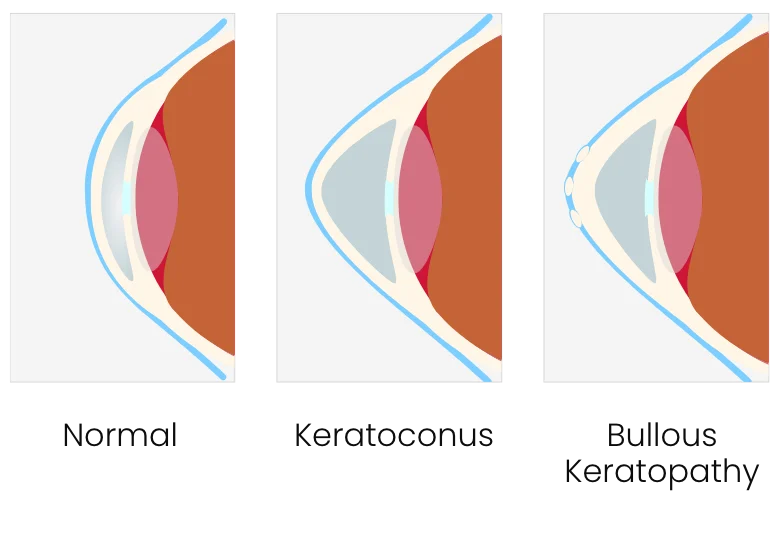
Keratoconus is a progressive eye condition that causes the cornea to thin and bulge into an irregular cone shape. This distorts vision over time. As the condition advances, it can make everyday tasks like reading and driving increasingly difficult without treatment.
The cornea is the clear, dome-shaped surface at the front of the eye. It normally holds a smooth, round shape that focuses light onto the retina. In keratoconus, weakened collagen fibers allow the cornea to thin and bulge forward into a cone. This change scatters incoming light instead of focusing it, creating blurred and distorted vision.
Keratoconus usually begins during the teenage years or early twenties and can affect one or both eyes. Common signs include:
- Blurred or wavy vision that changes often
- Growing sensitivity to light and glare
- Frequent changes to your glasses or contact lens prescription
- Halos or streaking around lights at night
- Increasing astigmatism that is hard to correct with lenses alone


What Causes Keratoconus?
An imbalance of enzymes weakens the cornea’s collagen structure over time. This leaves the tissue vulnerable to damage from free radicals, causing it to thin and bulge forward. Genetics play a role, and keratoconus often runs in families. Chronic eye rubbing, poorly fitted contact lenses, and long-term ultraviolet exposure are also linked to disease progression.
How Do We Treat Keratoconus?
Treatment depends on how far your keratoconus has progressed. Mild cases may only need glasses or soft contact lenses. As the disease advances, we recommend specialty lenses, cross-linking, or surgery to stabilize the cornea and protect your vision.
Custom Contact Lenses for Keratoconus
For moderate to advanced keratoconus, specialty contact lenses often provide the clearest vision. Dr. David Geffen, OD, has fitted custom lenses for keratoconus patients since 1994.
- Custom soft contact lenses, made to the exact measurements of your eye
- Rigid gas permeable lenses, which vault over the cornea’s irregular shape
- Hybrid lenses, combining a rigid center with a soft outer skirt
- Scleral lenses, a larger design that rests on the white of the eye for added comfort
What Is Epioxa Cross-Linking?
Epioxa is the first and only approved epithelium-on, oxygen-enriched cross-linking treatment for progressive keratoconus. Unlike earlier methods, Epioxa strengthens the cornea without removing its outer protective layer.
How Does Cross-Linking Strengthen the Cornea?
Cross-linking works by creating new bonds between collagen fibers inside the cornea. Riboflavin, a form of vitamin B2, is absorbed into the corneal tissue and activated by ultraviolet light. This reaction stiffens the cornea so it resists further thinning and bulging. Cross-linking is designed to halt the progression of keratoconus, though it does not reverse damage that has already occurred. Many patients continue wearing glasses or contact lenses after treatment.
How Is Epioxa Different From Traditional Cross-Linking?
Traditional cross-linking, known as the epi-off method, requires removing the cornea’s outer layer before applying riboflavin. This approach works well, but healing that layer back can take days and cause real discomfort. Epioxa uses a specially engineered, oxygen-enriched riboflavin formula that penetrates the intact epithelium. Two sequential formulations are applied to the eye, followed by ultraviolet light activation. Because no tissue is removed, patients typically experience less discomfort and a faster return to daily activities.
What Happens During Epioxa Treatment?
We perform Epioxa as an outpatient procedure using numbing eye drops for comfort. After applying the riboflavin formulations, we activate the cross-linking reaction with ultraviolet light in an oxygen-enriched environment. There is no incision, and no corneal tissue is removed. If both eyes need treatment, we treat one eye at a time to allow proper healing between procedures. Following treatment, you may notice mild light sensitivity or fluctuating vision for a short period. We prescribe drops to support healing and schedule follow-up visits to track your cornea’s stabilization over the following months.
Who Is a Candidate for Epioxa?
You may be a candidate for Epioxa if you have progressive keratoconus in the mild to moderate stage. You must also be 13 years of age or older. A comprehensive evaluation, including corneal imaging, helps our doctors confirm whether Epioxa is right for your eyes.
What Other Treatment Options Are Available?
Custom Contact Lenses for Keratoconus
For moderate to advanced keratoconus, specialty contact lenses often provide the clearest vision. Dr. David Geffen, OD, has fitted custom lenses for keratoconus patients since 1994.
- Custom soft contact lenses, made to the exact measurements of your eye
- Rigid gas permeable lenses, which vault over the cornea’s irregular shape
- Hybrid lenses, combining a rigid center with a soft outer skirt
- Scleral lenses, a larger design that rests on the white of the eye for added comfort
INTACS® Corneal Inserts
INTACS are small plastic inserts placed within the periphery of the cornea to reshape its surface and improve vision. The FDA approved INTACS for keratoconus in July 2004. The procedure takes about ten minutes in our office-based surgical suite. INTACS can improve best corrected vision by an average of two lines on a standard eye chart. The inserts can also be removed or exchanged if needed. INTACS may delay, but cannot prevent, the need for a corneal transplant if keratoconus continues to progress.
Corneal Transplant
When contact lenses and other treatments no longer provide functional vision, a corneal transplant may become necessary. Also called penetrating keratoplasty, this procedure replaces damaged corneal tissue with healthy donor tissue. Our surgeons have performed corneal transplants for many patients who have exhausted other treatment options. Many patients still need glasses or contact lenses for clear vision after a transplant.

Why Choose Gordon Schanzlin New Vision Institute?
Our cornea team brings decades of combined experience to keratoconus care, from specialty contact lens fitting to advanced surgical treatment.
- Dr. Michael Gordon, MD: Founding partner with more than 45 years of experience; performed the world’s first all-laser custom wavefront-guided LASIK.
- Dr. Alison Gordon: Board-certified ophthalmologist specializing in refractive surgery, cataract surgery, and corneal diseases, with more than 15 years of experience.
- Dr. David Schanzlin, MD: Corneal specialist with more than 42 years of experience treating corneal disease.
- Dr. Julio Echegoyen, MD, PhD: Fellowship-trained cataract and corneal specialist.
- Dr. Rakhi Ammar: Board-certified ophthalmologist with specialized expertise in cornea, cataract, and refractive surgery.
- Dr. David Geffen, OD: Has fitted specialty contact lenses for keratoconus patients since 1994.
Our doctors helped drive the clinical research that led to FDA approval of INTACS and corneal cross-linking. We continue bringing new treatments like Epioxa to our patients as they become available.
Frequently Asked Questions About Keratoconus and Epioxa
Is Epioxa treatment painful?
We use numbing eye drops throughout the procedure. Because Epioxa does not require removing the epithelium, many patients report far less discomfort than with traditional cross-linking.
Does insurance cover keratoconus treatment?
Coverage varies by plan and is typically based on medical necessity. Many insurers cover cross-linking when progressive keratoconus is documented, and our team can help verify your benefits before your consultation.
What if I'm not a candidate for Epioxa?
Not every patient qualifies for Epioxa. If it isn’t the right fit, our doctors will discuss other options, including INTACS, specialty contact lenses, or corneal transplant, based on your stage of keratoconus.
Is keratoconus hereditary, and should my children be screened?
Keratoconus can run in families, so we recommend regular eye exams for children of parents or siblings with the condition. Early screening allows us to catch changes before they significantly affect vision.
How soon can I return to my normal routine after Epioxa?
Many patients resume light daily activities within a day or two, though we advise against driving until your vision feels stable. We will give you specific guidance at your post-procedure visit.
Schedule a Keratoconus Consultation
If you live in San Diego or La Jolla and have noticed changes in your vision, do not wait to get evaluated. Schedule a consultation with our cornea specialists today.

 Sources
1 American Academy of Ophthalmology. “What Is Keratoconus?” Accessed August 2026. https://www.aao.org/eye-health/diseases/what-is-keratoconus
2 Belin MW, Lim L, Rajpal RK, Hafezi F, Gomes JAP, Cochener B. “Corneal Cross-Linking: Current USA Status: Report From the Cornea Society.” Cornea. 2018;37(10):1218-1225. https://pubmed.ncbi.nlm.nih.gov/30067537/
3 National Keratoconus Foundation. “Intacs Surgery for Keratoconus.” https://nkcf.org/intacs-for-keratoconus/
4 Ophthalmology Advisor. “Novel Corneal Cross-Linking Therapy Epioxa Approved for Keratoconus.” October 21, 2025. https://www.ophthalmologyadvisor.com/news/novel-corneal-cross-linking-therapy-epioxa-approved-for-keratoconus/
The doctors at Gordon Schanzlin New Vision Institute have either authored or reviewed and approved this content.
Page Updated:

 Call
Call  Book
Book  Location
  Specials